

 Tracy Jackson15 yrs in online marketing
AI Writing Software for Blogging in 2026: Best Tools + How to Stay AI-Search Visible
Table of Contents
I first wrote this guide in 2023, when the big question about AI writing software for blogging was simply: can it produce a usable draft? In 2026, that question is settled. AI tools can absolutely produce content. The bar has moved.
The new question is sharper: can you produce content that AI search will actually cite? Google’s AI Overviews, ChatGPT, Perplexity, and Gemini now sit between your blog and a huge share of your readers. Generic AI output — the kind anyone can generate in one click — is exactly what these engines skip over. So this updated guide does two things: it gives you the AI writing tools genuinely worth using in 2026, and it shows you how to use them without becoming invisible to AI search.
That second part is called Generative Engine Optimization (GEO), and it’s the thread running through this whole piece. Let’s start with whether you even need these tools.

Affiliate disclosureSome links below are affiliate links. If you buy through them, I may earn a commission at no extra cost to you. I only recommend tools I’d actually use — the recommendations here are based on hands-on testing, not commission rates.
Do You Need AI Writing Software in 2026?
Honest answer: no, you don’t strictly need it. Plenty of excellent blogs are still written by hand. But the landscape has matured to the point where not using AI tools at all means leaving real time on the table — and time is the whole game in blogging.
Here’s where AI writing software genuinely helps in 2026: research and outlining, beating the blank page, drafting first-pass sections, repurposing one post into social copy, and checking structure against what’s already ranking. Where it still fails: original insight, genuine expertise, real data, and a point of view. Those are exactly the things both Google and AI search reward — and exactly the things AI can’t manufacture for you.
So the right framing isn’t ‘AI vs. human.’ It’s AI for speed and structure, human for the expertise that makes content worth citing. That balance is the entire point of the GEO section coming up next.
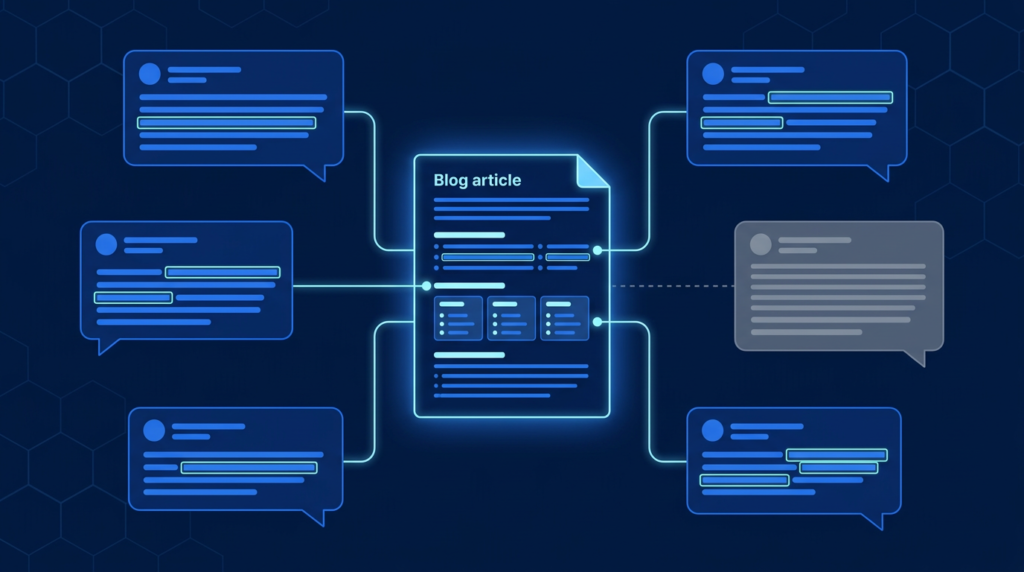
AI Writing Tools and Generative Engine Optimization (GEO): Creating Content AI Search Will Cite
This is the part that matters most in 2026. Generative Engine Optimization (GEO) is the practice of creating content that AI search engines — Google AI Overviews, ChatGPT, Perplexity, Gemini — will surface and cite when they answer a user’s question. It’s the natural evolution of SEO for an AI-first search world.
Here’s the link between AI writing tools and GEO, stated plainly: AI tools help you create content at scale, but creation is only half the battle. The other half is visibility — getting that content cited by the AI engines people now ask instead of typing a search query. You still have to produce well-structured, factually grounded, genuinely useful content. AI tools help you do that faster. They don’t do it for you.
And here’s the risk nobody selling you an AI writing subscription wants to mention: generic AI output is precisely what generative engines don’t cite. If you generate a 1,500-word post in one click and publish it untouched, you’ve created the exact kind of content AI search has learned to ignore — undifferentiated, source-less, and indistinguishable from a million other one-click posts. AI engines surface content with original data, clear structure, demonstrable expertise, and citable specifics. That’s the opposite of one-click output.
So the practical workflow that actually works for GEO in 2026 looks like this:
- Draft and structure with AI — use the tools to research, outline, and get a first draft down fast. This is where AI genuinely saves hours.
- Add what AI can’t — your original insight, real statistics, first-hand experience, specific examples, and a clear point of view. This is what makes content citable.
- Format for extraction — clear headings, direct answers near the top of sections, structured data and FAQ schema, and concise factual statements AI engines can lift cleanly.
Do that, and AI tools become a GEO advantage instead of a GEO liability. Skip the middle step, and no amount of tooling will get you cited. AI tools are a starting line, not a finish line — that single distinction is the most important thing in this entire guide.

The Best AI Writing Tools for Blogging in 2026
I’ve grouped these by what they’re actually best at, because the category split hard since I first wrote this guide. In 2023, these were all roughly ‘AI writers.’ In 2026, some have leaned into GEO and AI-search visibility, while others stayed focused on pure drafting. Here’s the current lineup, with pricing verified at the time of this update:
| Tool | From (verified 2026) | Best for | Why it’s on the 2026 list |
| Jasper | $59/mo (annual) | Brand-led teams | Now markets SEO/AEO/GEO directly; brand voice; GEO Diagnostic tool |
| Writesonic | $79/mo (annual) | GEO-first creators | Repositioned as an AI Search Visibility platform; tracks ChatGPT, Gemini, AI Overviews |
| Surfer SEO | $79/mo (annual) | Optimisation-led writers | Added GEO & AI citation scoring in 2026; SERP-based content editor |
| Frase | $45/mo | Research + briefs | Dual SEO + GEO scoring across AI platforms; strong SERP briefs |
| Outranking | $19/mo (Starter) | SEO research + drafting | SERP-driven research and drafts, automatic internal linking, content briefs |
| Rytr | $7.50/mo (Unlimited) | Budget / short-form | Cheapest of the group; fine for short-form, light on GEO depth |
Jasper — best for brand-led content teams
Jasper is still a market leader in 2026, and it’s evolved in a direction that fits this article perfectly: it now markets SEO, AEO, and GEO as a core solution and even ships a GEO Diagnostic that tells you what AI engines say about your brand. Pricing is $59/month on the Pro plan (billed annually), or $69 month-to-month, with custom Business pricing above that.
When I tested Jasper for this guide back in 2023, it was just getting noticed — and it was a real learning curve. It didn’t deep-dive. You had to revise almost everything it produced. I’d feed it a prompt and get back thin content that Google would flag as AI-written, which made it hard to rank — back then, AI content was easy to detect. Fast-forward to 2026: the technology has advanced, the output is far harder to detect, and Jasper is genuinely strong. But here’s what hasn’t changed — you still have to edit it and add a human touch to anything it produces. That part never went away.
Where it fits: teams that need on-brand content at volume and want the AI to learn a brand voice. Its brand-voice feature is genuinely the strongest in this group.
Writesonic — best for GEO-first creators
Writesonic is the clearest example of how this category changed. When I first covered it, it was a straightforward AI writer. In 2026 it has repositioned entirely as an AI Search Visibility platform — it tracks whether your brand shows up across ChatGPT, Gemini, and Google AI Overviews, audits your site for AI-search gaps, and still includes an AI article writer. Pricing starts at $79/month (Starter, annual), scaling to $199 and $399 for larger needs.
Where it fits: bloggers and creators who want content creation and AI-search visibility tracking in one place. If GEO is your priority — and in 2026 it should be on your radar — Writesonic is built around exactly that question now.
Surfer SEO — best for optimisation-led writing
Surfer wasn’t in my original lineup, and it’s earned a spot. It’s a content optimisation platform — you write (or paste) a draft, and it scores you in real time against what’s already ranking, recommending structure, terms, and depth. In 2026 it added GEO and AI-citation scoring, giving you a dual read on Google readiness and AI-search readiness. Pricing starts at $79/month on the Essential plan (annual).
Where it fits: writers who already have a process but want data-backed optimisation before they publish. It’s not a one-click writer — it’s a structure-and-coverage check, which is exactly what GEO rewards.
Frase — best for research and briefs
Frase is the other strong 2026 addition. It’s research-driven: it pulls SERP data into content briefs fast, then helps you write against them, with dual SEO + GEO scoring across AI platforms in the core product. Plans start around $45/month, with a free trial to test it first.
Where it fits: solo creators and small teams who want to go from keyword to a structured, research-backed brief quickly — and want GEO scoring baked in rather than as a pricey add-on.
Outranking — best for SEO research and drafting
Outranking survives the 2026 cut as a SERP-driven research and writing tool. It builds drafts from real-time SERP analysis, handles content briefs, and does automatic internal linking — useful for bloggers building topical clusters. Starter is $19/month (4 SEO documents), with SEO Writer at $79 and SEO Wizard at $159 for higher volume.
When I tested Outranking originally, it was just getting started — and it showed. The software was clunky and the content wasn’t great. You could almost always tell it was AI-written; it leaned generic. Back then, Jasper clearly outperformed it. Today it’s a different tool. Outranking has stepped up and become one of the market leaders, and where it really shines now is research — it digs in and gives you full, substantive answers. In 2026, this is the tool I reach for as a research agent.
Where it fits: bloggers who want an SEO research and drafting workflow and care about internal linking across a content cluster.
Rytr — best budget option
Rytr is the one tool from my original list that’s stayed in its lane — and that’s fine. It’s still the cheapest serious option: a free tier, Unlimited at $7.50/month, and Premium at $24.16/month. It’s a capable short-form and first-draft writer.
When I tested Rytr in 2023, it was the same story as the rest — clunky, and entirely dependent on getting the prompt exactly right or it wouldn’t produce anything usable. It was one of the cheapest tools out there even then, but it also produced some of the thinnest content of the group. Today it’s improved where it counts: Rytr now writes in your voice and doesn’t sound nearly as robotic as it used to. And it’s still the cheapest serious option — I verified that for this update.
Where it fits: beginners, hobby bloggers, and anyone who wants to test the AI-writing waters cheaply. Just know its GEO depth is light — you’ll be doing the structure and optimisation work yourself.
Three tools from the original guide — and what happened to them
In the interest of being honest rather than leaving stale recommendations in place, here’s what became of three tools I featured in 2023:
- AI-Writer has repositioned as an academic and scientific research writer — it now answers questions from a corpus of 100M+ peer-reviewed papers with proper citations. Genuinely interesting for researchers, but no longer a general blogging tool, so I’ve removed it from the main list.
- Article Forge is still around as a full-auto, one-click article generator (~$27/month). I’m deliberately not recommending it for 2026: fully-automated, hands-off content is precisely the kind of generic output AI search engines don’t cite. It’s the cautionary example for everything the GEO section warns about.
- GrowthBar has been acquired by SEOptimer and is being merged into that platform. The Chrome extension now ships with SEOptimer subscriptions. If you used GrowthBar, check SEOptimer for current plans before renewing.

How to Use AI Writing Tools Without Killing Your SEO or GEO
This is the practical companion to the GEO section. The tools are fine; the way most people use them is the problem. Here’s what actually protects your visibility:
- Edit everything — never publish raw AI output. Rewrite the intro, vary the rhythm, cut the filler phrases AI loves. Raw output reads like raw output, and both readers and engines can tell.
- Add original data and experience — a statistic you gathered, a screenshot from your own testing, a result you actually got. This is the single biggest GEO signal AI can’t fake for you.
- Fact-check every claim — AI tools still hallucinate numbers, dates, and sources. Verify before you publish; a wrong stat that gets cited is worse than no citation.
- Structure for extraction — clear H2/H3 headings, a direct answer near the top of each section, FAQ schema, and concise factual sentences. AI engines lift clean, well-structured statements; they skip rambling paragraphs.
- Keep a point of view — say what you actually think. Generic ‘on the one hand, on the other hand’ content is forgettable to readers and invisible to AI search. Opinion, backed by experience, is citable.

Free vs. Paid AI Writing Tools
Free tools have come a long way — Rytr has a real free tier, and general assistants like ChatGPT and Gemini cover a lot of drafting for nothing. So is paid worth it?
For a hobby blog or someone just starting out, a free tier is genuinely enough to learn the workflow. The moment blogging becomes a business — where time saved translates to money earned, and where AI-search visibility affects traffic — paid tools start paying for themselves. The features that matter most for GEO (SERP-based optimisation, GEO scoring, content briefs, AI-search tracking) are almost all paid-tier features. Free gets you drafting; paid gets you the structure-and-visibility layer that GEO actually requires.
My honest rule of thumb: start free to learn the workflow, upgrade the moment you’re publishing regularly and need the optimisation and visibility features. Don’t pay for a tool until you’ve hit the ceiling of a free one.
Frequently Asked Questions
What is the best AI writing software for blogging in 2026?
There’s no single best tool — it depends on your priority. For brand-led content, Jasper. For GEO and AI-search visibility, Writesonic. For optimisation-led writing, Surfer SEO. For research and briefs, Frase. For budget, Rytr. The best choice matches whether you care most about brand voice, AI-search visibility, optimisation, or cost.
Does AI-written content rank in Google AI Overviews?
It can, but not automatically. AI Overviews and other generative engines cite content with original data, clear structure, demonstrable expertise, and factual specifics — not generic one-click output. AI-written content that’s been edited, fact-checked, given original insight, and properly structured can absolutely be cited. Raw, unedited AI output is exactly what these engines skip. The tool isn’t the deciding factor; what you add to its output is.
Is it bad for SEO to use AI writing tools?
No — using AI tools isn’t penalised. Google’s guidance rewards helpful, high-quality content regardless of how it’s produced. What gets penalised is low-quality, unhelpful content, which is easy to mass-produce with AI but isn’t caused by AI. Use the tools to draft and structure, then add the expertise and accuracy that make content genuinely useful, and you’re fine.
What’s the difference between AI writing tools and GEO tools in 2026?
AI writing tools help you create content. GEO tools help you make that content visible in AI search. In 2026 the line is blurring — Jasper, Writesonic, Surfer, and Frase now combine both. Pure writers (like Rytr) focus on drafting; GEO-aware platforms add AI-search tracking and citation scoring. For blogging that needs to stay visible, you want a tool that does both, or a writer plus a GEO layer.
Can I just use ChatGPT instead of a dedicated AI writing tool?
For drafting, often yes — general assistants are capable writers. What they don’t give you is the SEO and GEO layer: SERP-based optimisation, content briefs built from ranking data, AI-search visibility tracking, and citation scoring. Dedicated tools wrap drafting inside a workflow built for visibility. If you only need drafts, ChatGPT is fine. If you need content that ranks and gets cited, the dedicated tools earn their cost.

The Bottom Line
Three years on from the first version of this guide, the headline has flipped. In 2023, the win was producing content faster. In 2026, the win is producing content that AI search will cite — and that takes more than a tool.
AI writing software amplifies; it doesn’t replace. The bloggers winning in 2026 use AI to create faster, then add the original data, genuine expertise, and clean structure that AI search rewards. Pick the tool that fits your priority from the list above, use it for speed and structure, and put your own expertise into everything you publish. That combination — fast creation plus human judgement — is what stays visible as search keeps changing.
Sources
Jasper pricing (verified 2026)
Writesonic pricing (verified 2026)

Recent Posts
Monday.com Review 2026: Is It Still the Best Work OS?
I tested Monday.com against ClickUp, Asana, and Wr...
Updated July 27, 2026
AI Writing Software for Blogging in 2026: Best Tools + How to Stay AI-Search Vis...
The best AI writing software for blogging in 2026 ...
Updated July 20, 2026
HubSpot Review 2026: Is It Worth the Cost?
I tested HubSpot’s free CRM, Starter, and Pr...
Updated July 20, 2026

Teamwork.com Review 2026: Is It the Best PM Tool for Client Work?
I tested Teamwork.com for agency and client projec...
Updated May 29, 2026
Wrike Review 2026: Is It Worth the Cost?
I tested Wrike in real enterprise workflows. Here&...
Updated May 29, 2026
Asana Review 2026: Is It Worth It? (Honest, In-Depth Analysis)
I tested Asana across real team workflows. Here...
Updated May 29, 2026
Newsletter
Don't miss a thing!
Sign up to receive daily news