 Tracy Jackson15 yrs in online marketing
Monday CRM Pricing (2026): Plans, True Costs & Honest Verdict
Table of Contents
Quick answer: Monday Sales CRM starts at $12 per seat per month on annual billing, with a 3-seat minimum on all plans. The four plans are Basic ($12), Standard ($17), Pro ($28), and Ultimate (custom pricing). Most B2B sales teams need Pro — it’s the first tier where email sequences, mass email, and meaningful automations unlock. At a 3-seat minimum, the true entry price is $36/month, not $12.
I’ve reviewed Monday CRM pricing directly from monday.com. Before getting into the numbers, there’s one thing worth clarifying upfront — because it’s the most common source of confusion in this category.
For a full comparison of the best CRM for sales teams across eight platforms, I cover that separately. If you’re already narrowed down to Monday Sales CRM and just need to understand the plans, jump to the breakdown below.
Disclaimer: If you buy something using the links in this article, I may receive a commission at no extra cost to you.
Know that I only promote stuff that I use and trust for the sake of my readers and the reputation of this site.
Monday Sales CRM vs monday.com: What’s the Difference?
This is the question that trips up most buyers — and no competitor page answers it clearly.
monday.com is a Work OS — a project management and workflow platform. It’s what most people mean when they say “we use monday.” It has boards, timelines, automations, and a huge template library.
You can build a CRM-like structure inside monday.com using a CRM template, and it’s included in your Work OS subscription.
Monday Sales CRM is a separate, purpose-built CRM product on the monday.com platform. It has a dedicated pipeline view, contact management, lead routing, email sequences, sales forecasting, and features designed specifically for B2B sales teams.
It is priced and sold separately from monday.com Work OS.
Here’s the practical implication: If your team is already paying for monday.com Work OS, upgrading to Monday Sales CRM means paying for both products — not upgrading within your existing plan.
You don’t get Monday Sales CRM by upgrading your Work OS tier. It’s a separate subscription.
This is the most important thing to understand before evaluating Monday Sales CRM pricing. The rest of the article assumes you’re evaluating Monday Sales CRM as a standalone purchase.
Monday Sales CRM Pricing Plans: Full Breakdown
Monday Sales CRM has four plans. All prices are verified from monday.com as of May 2026. A 3-seat minimum applies on all plans.
| Plan | Annual (per seat/mo) | Monthly (per seat/mo) | Best for |
|---|---|---|---|
| Basic | $12 | $18 | Very small teams, basic contact tracking |
| Standard | $17 | $25 | Growing teams needing dashboards and automations |
| Pro | $28 | $41 | Sales teams needing email sequences and mass email |
| Ultimate | Custom | Custom | Enterprise — security, HIPAA, advanced governance |
Prices verified May 2026 — monday.com. 3-seat minimum on all plans.
Basic — $12/seat/mo (annual) The entry point. Basic gives you a centralized communications hub, iOS and Android apps, 1,000 active contacts and deals, 1 custom dashboard, 5 columns per board, 20 quotes and invoices per month, and 1 workspace. What it doesn’t give you: automations, mass email, or email sequences.
For a 3-person team tracking a small pipeline manually, Basic works. For any team that needs to send email at scale or automate follow-ups, it falls short immediately.
Standard — $17/seat/mo (annual) Standard adds 250 custom automations per month, 10,000 active contacts and deals, 5 custom dashboards, 15 columns per board, 50 quotes and invoices per month, and 3 workspaces. Mass email and email sequences are still not included.
Standard is the right tier for a small team that needs organized pipeline management and basic automation — but if outbound email is part of your sales motion, you’ll hit the wall quickly.
Pro — $28/seat/mo (annual) This is where Monday Sales CRM becomes a genuine sales tool. Pro unlocks email sequences, mass email, 25,000 custom automations per month, unlimited contacts and deals, 50 custom dashboards, 75 columns per board, 250 quotes and invoices per month, and 15 workspaces.
The jump from Standard to Pro ($11/seat) is justified the moment your team is sending outbound email or running sequences. Pro is the plan most active B2B sales teams should start on.
Ultimate — Custom pricing Ultimate adds security and governance controls, multi-level permissions, HIPAA compliance, enterprise-grade support, and advanced log rules (coming soon). Monday notes this is a rebranded version of what was previously called Enterprise.
For most SMB teams, Pro covers 90% of Monday Sales CRM’s functionality. Ultimate is built for organizations with compliance requirements or enterprise IT governance needs.
Monday CRM Annual vs Monthly Billing
Annual billing saves 18% compared to monthly, per monday.com’s published pricing structure.
| Plan | Annual (per seat/mo) | Monthly (per seat/mo) | Annual savings per seat/yr (18%) |
|---|---|---|---|
| Basic | $12 | $18 | ~$72 |
| Standard | $17 | $25 | ~$96 |
| Pro | $28 | $41 | ~$156 |
Prices verified May 2026 — monday.com.
The 18% savings is consistent across all plan tiers. A 10-person team on Pro saves approximately $1,560/year by choosing annual over monthly.
If you’re committing to Monday Sales CRM as your CRM, annual is the right default.
The 3-seat minimum matters more than most buyers realize. Every plan requires a minimum of 3 seats, whether you use them or not. That means:
- A solo founder or 2-person team on Basic pays $36/month minimum (annual), not $12
- A 2-person team on Pro pays $84/month minimum (annual), not $56
- There is no single-seat option on any plan
If you have fewer than 3 active users, you’re paying for seats you don’t need. Factor this into your true cost comparison.
True Monday CRM Cost: 5, 10, and 25 Users
Annual billing, US list prices. 3-seat minimum applies. Verified May 2026.
| Plan | 3 Users/mo (min) | 5 Users/mo | 10 Users/mo | 25 Users/mo | 10-user annual total |
|---|---|---|---|---|---|
| Basic | $36 | $60 | $120 | $300 | $1,440 |
| Standard | $51 | $85 | $170 | $425 | $2,040 |
| Pro | $84 | $140 | $280 | $700 | $3,360 |
| Ultimate | Custom | Custom | Custom | Custom | Contact sales |
For a full picture of how CRM pricing compares across tools, I cover that in a separate guide.
What’s Actually Included in Each Monday CRM Plan?
Here’s the feature map across plans — the things that actually drive buying decisions.
| Feature | Basic | Standard | Pro | Ultimate |
|---|---|---|---|---|
| Active contacts & deals | 1,000 | 10,000 | Unlimited | Unlimited |
| Custom dashboards | 1 | 5 | 50 | Unlimited |
| Custom automations/mo | None | 250 | 25,000 | Enterprise-scale |
| Mass email | No | No | Yes | Yes |
| Email sequences | No | No | Yes | Yes |
| Quotes & invoices/mo | 20 | 50 | 250 | Unlimited |
| Workspaces | 1 | 3 | 15 | Unlimited |
| HIPAA compliance | No | No | No | Yes |
| Security & governance | No | No | No | Yes |
The sharpest cliff in this table is between Standard and Pro. If your team needs email sequences or mass email — which most active B2B sales teams do — Standard simply doesn’t include them. Pro is the effective entry point for a real sales motion.
Which Monday CRM Plan Do Most B2B Teams Actually Need?
3–5 person team, light sales activity: Basic ($12/seat) works if you’re tracking a small pipeline manually and don’t need outbound email at scale. The 1,000 contact limit and single dashboard are constraints, but manageable for a very small team.
Upgrade to Standard when you hit the contact cap or need more automations.
5–15 person team with active outbound: Pro ($28/seat) is where you need to start. Email sequences and mass email are table stakes for an active outbound motion. Standard’s 250 automations/month is a real constraint for a team of 5+ running structured follow-up workflows.
Don’t buy Standard expecting to upgrade later — buy Pro from day one if outbound is central to your process.
15+ person team or complex workflows: Pro handles most needs at this scale. Consider Ultimate only if you have HIPAA compliance requirements, enterprise IT governance, or multi-level permission structures.
The honest buying advice: Most buyers who land on Basic or Standard discover within 60 days that they need Pro. The 3-seat minimum means you’re already paying more than the entry price — adding $11/seat to jump to Pro is a smaller step than it looks on paper.
Monday CRM vs Pipedrive: Which Is Better Value?
The most common cross-shop for Monday Sales CRM is Pipedrive. Here’s the direct cost comparison at 10 users.
| Monday Sales CRM Pro | Pipedrive Growth | |
|---|---|---|
| Price (annual) | $28/seat/mo | $39/seat/mo |
| 10-user monthly cost | $280 | $390 |
| 10-user annual total | $3,360 | $4,680 |
| Free tier | No (14-day trial) | No (14-day trial) |
| Seat minimum | 3 seats | None |
| Email sequences | Yes | Yes |
| Automations | 25,000/mo | Included |
| Native dialer | No | No (add-on required) |
| Built for sales-first | Hybrid (CRM + project mgmt) | Sales-first |
Monday Sales CRM Pro is cheaper than Pipedrive Growth by $1,320/year for a 10-person team. That’s a real difference. But the framing matters: Pipedrive is built exclusively for sales pipeline management, while Monday Sales CRM is a CRM module on a work management platform.
If your team’s primary tool is already monday.com and you want CRM in the same workspace, Monday Sales CRM wins on integration and familiarity. If you’re starting fresh and want a CRM-first tool, Pipedrive’s pricing reflects a product built ground-up for sales.
Monday CRM vs HubSpot: Is the Free Tier Relevant?
HubSpot offers a free Sales Hub tier — unlimited users, basic pipeline management, Gmail/Outlook integration. Monday Sales CRM has no free tier and requires a 3-seat minimum on all paid plans.
| Monday Sales CRM Standard | HubSpot Sales Hub Starter | |
|---|---|---|
| Price (annual) | $17/seat/mo | $9/seat/mo |
| 5-user monthly cost | $85 | $45 |
| 5-user annual total | $1,020 | $540 |
| Free tier | No | Yes (unlimited users, limited features) |
| Email sequences | No (requires Pro) | No (requires Professional) |
| Automations | 250/mo | Basic |
| Contact limit | 10,000 | Unlimited |
HubSpot Sales Hub Starter at $9/seat is significantly cheaper than Monday Standard at $17/seat — and HubSpot’s free tier gives you a genuine starting point before committing to paid.
If cost is the primary driver and your team doesn’t already live in monday.com, HubSpot is the stronger value at the entry and mid-market tiers.
Should Existing monday.com Users Upgrade to Sales CRM?
This is the core question for a lot of readers — and it deserves a straight answer.
If you’re using a CRM template inside monday.com Work OS: That template is included in your Work OS subscription. It gives you basic pipeline and contact management without an additional cost. If it’s working for your team, there’s no reason to upgrade.
The CRM template falls short when: You need email sequences, lead scoring, sales forecasting, or advanced sales-specific reporting. These features live in Monday Sales CRM — not the Work OS template.
The cost reality of upgrading: If you’re on monday.com Work OS Pro (part of the Work OS pricing structure, separate from Sales CRM), upgrading to Monday Sales CRM Pro means paying an additional $28/seat/month on top of your existing Work OS cost.
For a 10-person team, that’s $280/month — $3,360/year — on top of what you’re already paying for the Work OS platform.
When the upgrade makes sense: Your team is already highly productive in monday.com, switching to a new CRM platform would cause adoption friction, and you specifically need Sales CRM features (sequences, forecasting) that the Work OS template doesn’t cover.
When the upgrade doesn’t make sense: You don’t need the advanced sales features and the Work OS template is sufficient, or your team isn’t deeply embedded in monday.com and a dedicated CRM like Pipedrive or HubSpot would be a cleaner, cheaper starting point.
Monday CRM Add-Ons and Extra Costs
Monday Sales CRM’s base plan pricing is relatively clean — most core features are bundled into the plan tiers rather than sold as separate add-ons. A few areas worth flagging:
Automation overages: Monday Sales CRM does not sell overage actions. When you hit your monthly action limit, automations stop running until the next billing cycle resets. Monday sends email notifications to account admins at 50%, 75%, and 100% of the allotted actions used — so you get advance warning before automations go dark.
If you’re consistently hitting the limit, the only option is to upgrade to the next plan tier. Standard’s 250 actions/month is a real constraint for any team running more than basic workflows — Pro’s 25,000 actions/month covers most active sales teams comfortably.
Integrations: Standard integrations (Google Workspace, Slack, Zapier) are included. Some enterprise-level integrations may require higher tiers or additional configuration.
Guest access: Basic plan does not include shareable boards — guests are not available on Basic at all. Standard includes guests with a 4:1 billing ratio: every 4 guests count as 1 billed seat, meaning up to 3 guests are free.
Pro and Ultimate include unlimited guests at no additional seat cost.
monday.com Work OS: If your team needs Work OS features alongside Sales CRM, budget for both subscriptions. There’s no bundle discount publicly listed for combining the two products.
Is Monday Sales CRM Free?
No. Monday Sales CRM has no free tier. There is a 14-day free trial available on all plans — no credit card required. The trial gives access to the full feature set of the plan you’re testing.
After the trial, the minimum commitment is 3 seats on Basic at $36/month (annual billing) or $54/month (monthly billing).
If a free CRM is essential, HubSpot’s free Sales Hub supports unlimited users with basic pipeline management at $0. Zoho CRM’s free plan covers up to 3 users with real CRM functionality.
Monday Sales CRM has no equivalent.
Monday CRM Enterprise (Ultimate): Is It Worth It?
Ultimate — previously called Enterprise — is custom-priced and targeted at organizations with security and compliance requirements. The key additions over Pro: security and governance controls, multi-level permissions, HIPAA compliance, enterprise-grade support, and advanced log rules.
For most SMB sales teams, Pro covers everything they need.
Ultimate makes sense when your organization operates in regulated industries (healthcare, finance, legal) where HIPAA compliance or advanced audit logging is a hard requirement, or when enterprise IT governance demands multi-level permission structures.
If you’re evaluating Ultimate, contact Monday’s sales team directly — pricing is negotiated based on seat count and contract length.
Is Monday Sales CRM Worth the Price?
Yes, if: Your team is already deeply embedded in monday.com’s Work OS and switching to a different CRM platform would create meaningful adoption friction.
The familiarity of the monday.com interface, combined with Sales CRM’s purpose-built sales features, makes the upgrade genuinely compelling for teams that live in monday.com all day.
Yes with caveats, if: You’re a small team under 5 people. The 3-seat minimum means you’re paying for unused seats from day one, and the effective entry price is higher than it looks. Run the true cost for your actual team size before committing.
Probably not, if: You’re starting from scratch and evaluating CRMs without an existing monday.com investment. At the same price point, Pipedrive Growth ($39/seat) is built exclusively for sales and offers a more focused pipeline management experience.
HubSpot’s free tier gives you a genuine starting point at $0.
Zoho CRM Professional ($23/seat) delivers comparable automation at a lower per-seat cost. For a full comparison of Monday Sales CRM alternatives, I cover those options separately.
The bottom line: Monday Sales CRM is the right CRM for teams that want their sales workflow inside the monday.com platform. It’s not the right CRM for teams evaluating CRMs cold. That distinction matters more than any feature comparison.
What to Do Next
Start the 14-day free trial — no credit card required. Test on the Pro plan, since that’s the tier where the full sales feature set unlocks.
FAQ
How much does Monday CRM cost per month? Monday Sales CRM starts at $12/seat/month on annual billing with a 3-seat minimum — so the true minimum monthly cost is $36/month. Plans are Basic ($12), Standard ($17), Pro ($28), and Ultimate (custom).
Monthly billing is higher: Basic $18, Standard $25, Pro $41 per seat. All prices verified from monday.com, May 2026.
Is Monday Sales CRM free? No. There is no free tier on Monday Sales CRM. A 14-day free trial is available on all plans with no credit card required. The minimum paid commitment is 3 seats on any plan. If a free CRM is a requirement, HubSpot Sales Hub (unlimited users, basic pipeline at $0) or Zoho CRM (up to 3 users free) are the strongest alternatives.
Is Monday Sales CRM worth it? For teams already using monday.com Work OS, yes — the integration and workflow familiarity justify the additional cost if you need dedicated CRM features. For teams starting fresh, dedicated CRMs like Pipedrive or HubSpot offer more sales-focused functionality at comparable or lower price points.
The answer depends almost entirely on whether your team is already in the monday.com ecosystem.
What is the difference between monday.com and Monday Sales CRM? monday.com is a work management platform (Work OS) used for project management, workflows, and team collaboration. Monday Sales CRM is a separate, purpose-built CRM product on the same platform — with dedicated pipeline management, contact management, email sequences, and sales-specific features.
They are priced and sold separately. Existing monday.com users who want Monday Sales CRM pay for both products — the Sales CRM is not included in a Work OS subscription.
Sources

Recent Posts
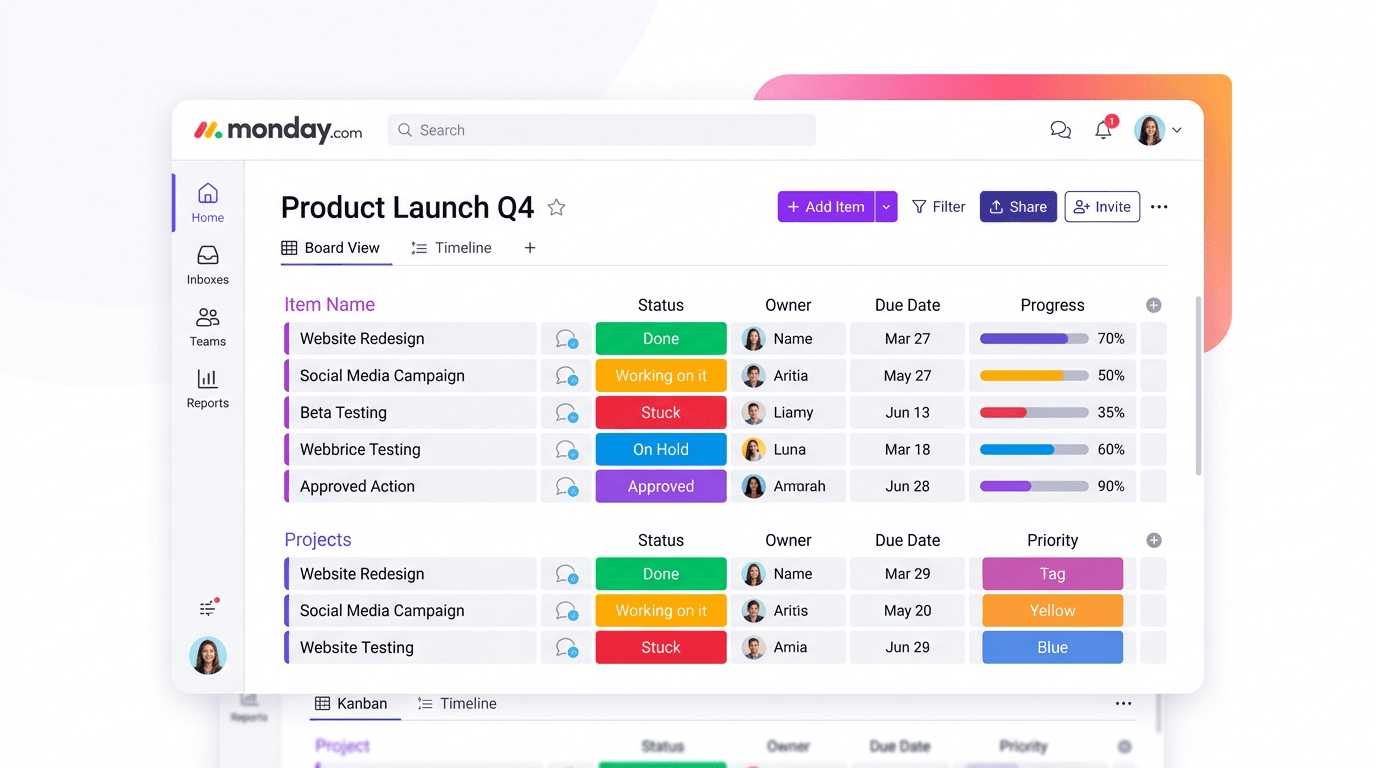
Monday.com Review 2026: Is It Still the Best Work OS?
I tested Monday.com against ClickUp, Asana, and Wr...
Updated July 27, 2026

AI Writing Software for Blogging in 2026: Best Tools + How to Stay AI-Search Vis...
The best AI writing software for blogging in 2026 ...
Updated July 20, 2026
HubSpot Review 2026: Is It Worth the Cost?
I tested HubSpot’s free CRM, Starter, and Pr...
Updated July 20, 2026
Teamwork.com Review 2026: Is It the Best PM Tool for Client Work?
I tested Teamwork.com for agency and client projec...
Updated May 29, 2026
Wrike Review 2026: Is It Worth the Cost?
I tested Wrike in real enterprise workflows. Here&...
Updated May 29, 2026
Asana Review 2026: Is It Worth It? (Honest, In-Depth Analysis)
I tested Asana across real team workflows. Here...
Updated May 29, 2026
Newsletter
Don't miss a thing!
Sign up to receive daily news