
 Tracy Jackson15 yrs in online marketing
Nonprofit CRM Pricing: What You’ll Really Pay in 2026 (All Models Compared)
Table of Contents
The short answer: Small nonprofits typically pay $1,200–$3,600/year for a mid-tier CRM subscription. But the subscription price is rarely what the organisation actually pays in year one — implementation, onboarding, and add-on costs routinely double or triple the sticker price. This guide covers eight platforms across two categories, a Salesforce total cost of ownership breakdown that no vendor article will show you, and a budget-tier framework so you know which CRM category makes sense before you book a demo.
Nonprofit CRM pricing is deliberately hard to compare.
Vendors use incompatible pricing models — per user, per record, flat monthly, revenue-based — which means a $99/month platform and a $125/month platform can serve completely different team sizes and look identical on a pricing page.
Add the fact that most top-10 search results for nonprofit crm pricing are written by vendors promoting their own products, and the reader has almost no independent reference point.
This guide fixes that. I cover the best software for nonprofits across five categories, and CRM is the category where I see the most confusion about what things actually cost. Before you click on a vendor’s pricing page, read this.
Disclosure: This article contains affiliate links. If you sign up for ClickUp through links on this page, I may earn a commission at no extra cost to your organization.
This does not affect my recommendations — all tools are independently tested and reviewed.
How to Read This Guide
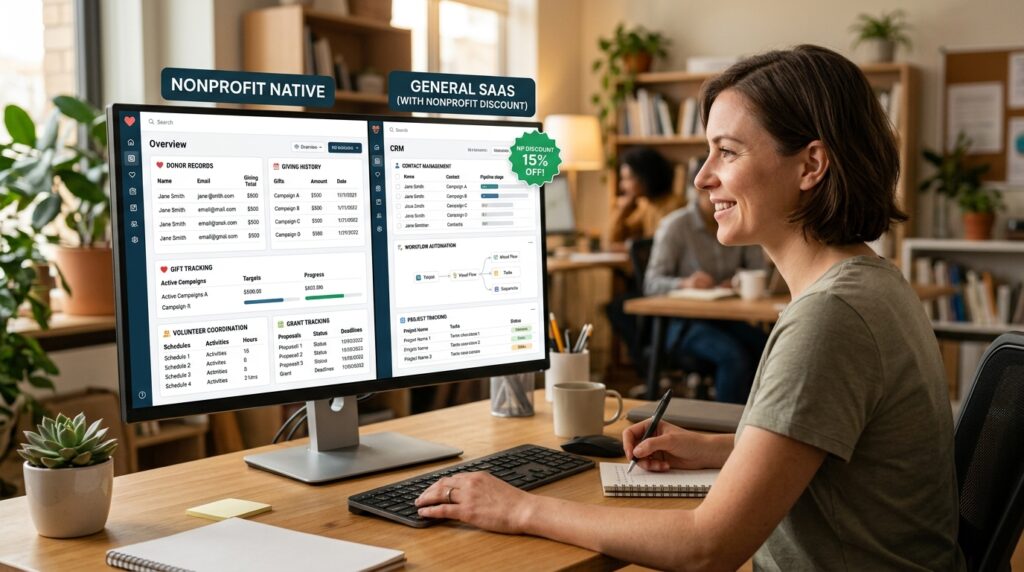
This article covers two distinct CRM categories that serve different nonprofit needs:
Purpose-built donor management CRMs (Bloomerang, NeonCRM, Little Green Light, Salesforce NPSP) are designed specifically for nonprofit operations — donor records, gift tracking, campaign management, volunteer coordination.
Their pricing is either nonprofit-native (no application needed) or accessed via TechSoup/Power of Us.
General-purpose SaaS CRMs with nonprofit discounts (HubSpot, Monday.com, Asana) are commercial platforms that offer formal nonprofit discount programs.
They’re not built specifically for donor management, but they cover contact management, workflow automation, and project tracking at prices that become very competitive after the nonprofit discount is applied.
The right category depends on your primary use case — not the price tag alone. That’s what the budget framework at the end of this article helps clarify.
The Three Nonprofit CRM Pricing Models Explained
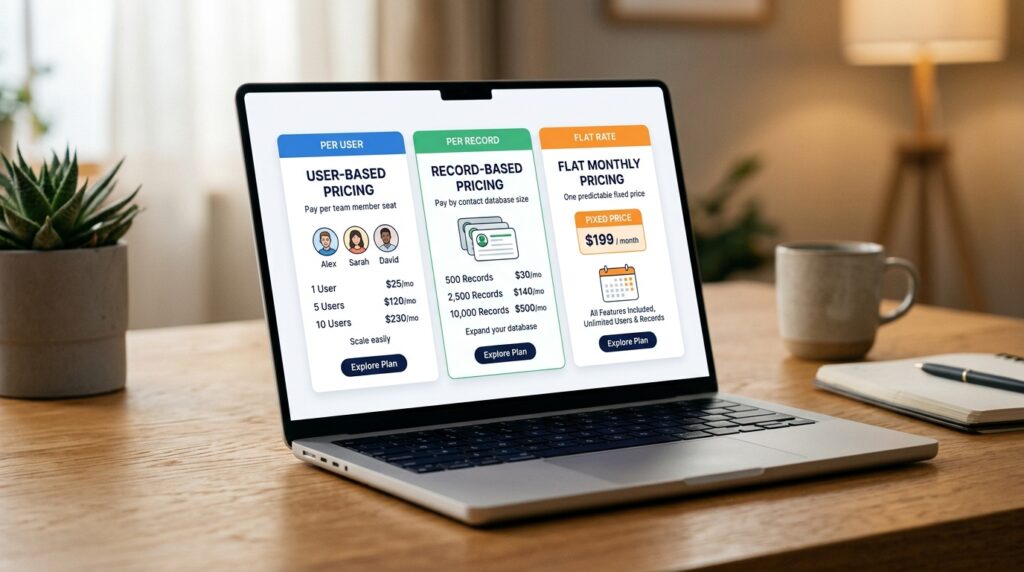
Per-user pricing: cheapest for small teams, expensive at scale
You pay a fixed amount per staff member who logs in each month. For a team of three, it’s affordable.
Add volunteers, seasonal staff, or board members and the cost climbs fast. Most general-purpose SaaS CRMs (HubSpot, Salesforce, Asana) use this model.
Watch out for: how each platform defines an “active user.” Some count all accounts including read-only viewers; others count only administrators.
A platform that offers “unlimited users” has already solved this — worth checking before assuming a per-user platform is cheaper.
Per-record pricing: predictable for stable donor bases
You pay based on the number of donor or contact records in your database, regardless of how many staff use the system.
Predictable if your donor list is stable. Expensive after a major fundraising campaign doubles your record count.
Watch out for: duplicate records. On a per-record model, duplicates cost real money. Budget time for database clean-up before migrating to this pricing model.
Flat monthly / revenue-based pricing: most predictable for budgeting
You pay a fixed monthly fee regardless of user count or record count.
NeonCRM uses tiered flat rates; Little Green Light charges a flat monthly fee based on constituent count.
Both are more predictable than per-user or per-record models for organisations with variable team sizes or growing donor bases.
Watch out for: feature module add-ons. A platform that advertises a flat fee sometimes converts to variable pricing once you add events management, volunteer tools, or API access.
Always check which features are included at each tier versus added-cost modules.
Nonprofit CRM Pricing Compared: Eight Platforms Side by Side
Purpose-built donor management CRMs
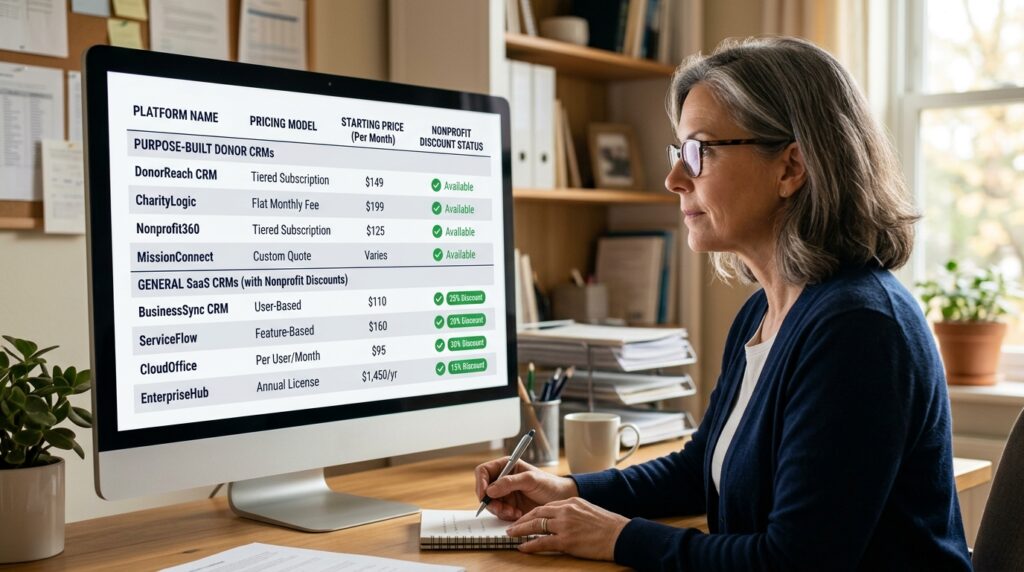
| CRM | Pricing model | Starting price/mo | Best for | Nonprofit discount? |
| Bloomerang | Per record | $125 (up to 1,000 records) | Small-mid donor management | No — nonprofit-native |
| NeonCRM | Tiered flat rate | $99 (Essentials) | Growing nonprofits needing events/volunteers | No — nonprofit-native |
| Little Green Light | Flat monthly | $45 | Small nonprofits, basic donor management | No — nonprofit-native |
| Salesforce NPSP | Per user | 10 free (Power of Us); ~$36+ after | Large nonprofits with IT staff | Yes — Power of Us via TechSoup |
Bloomerang: $125/month (≤1,000 records), $166/month (1,001–5,000), $249/month (5,001–15,000). Verified via grantpipe.com, April 2026. NeonCRM: Essentials $99/month, Impact $209/month, Empower $409/month. Verified via Capterra, April 2026. Little Green Light: $45/month starting price. Verified via Capterra, March 2026. Salesforce additional license pricing not published — contact Salesforce sales for a quote.
General-purpose SaaS CRMs with nonprofit discount programs
| CRM | Pricing model | Nonprofit price/mo | Best for | Discount |
| HubSpot Free | Free tier | $0 (no application needed) | Under 1,000 contacts, basic email | N/A — free for all |
| HubSpot Professional | Per seat + base | ~$480/month (40% off) | Marketing automation, donor segmentation | 40% off — North America, Australia, NZ only |
| Monday.com | Per seat | Free (≤10 seats Nonprofit Plan) | Project and campaign management | 10 free seats, then 70% off |
| Asana | Per seat | ~$5.50/seat/month (50% off) | Grant and project management | 50% off Starter — via Goodstack |
HubSpot Professional nonprofit price verified May 2026 — base plan includes 3 seats and 2,000 contacts. Monday and Asana discount rates verified at program pages, May 2026. All discount programs subject to eligibility requirements and program terms. See individual guides (linked above) for full eligibility details.
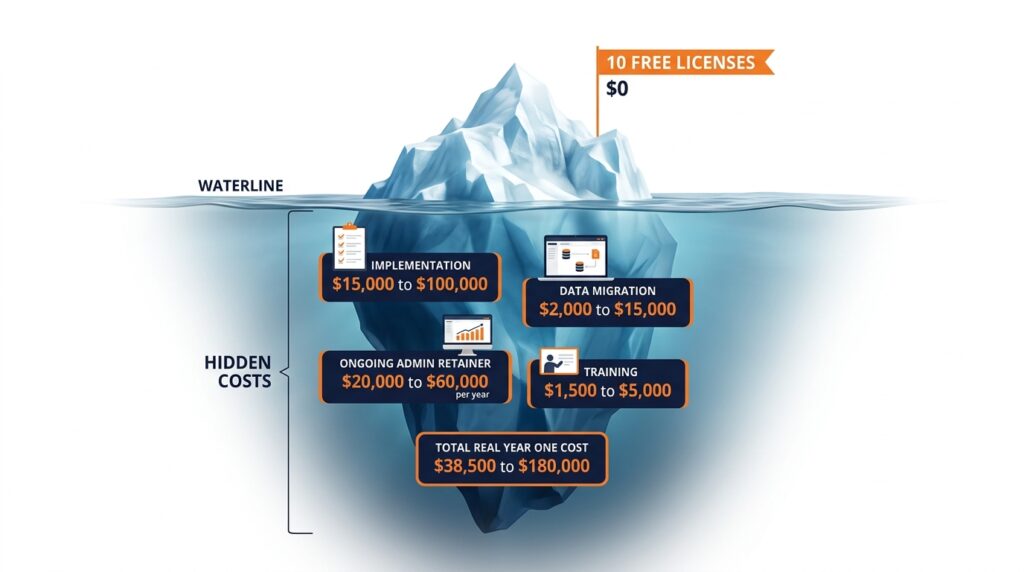
Salesforce Nonprofit Pricing: What the 10 Free Licenses Actually Cost
This is the section that no Salesforce article will write for you.
The TechSoup Power of Us program: what’s free and what isn’t
Through the Power of Us program, eligible nonprofits receive 10 free Salesforce Nonprofit Cloud licenses.
These are full Enterprise Edition licenses — not a stripped-down tier.
The 10 free seats cover: donor management via NPSP (Nonprofit Success Pack), grant tracking, program management, volunteer coordination, and reporting.
What the free licenses don’t cover: implementation, data migration, custom development, or ongoing administration.
Salesforce does not publish a fixed per-user rate for additional licenses beyond the 10 free seats — the current discount is described as “up to 80% off commercial pricing” and requires a conversation with a Salesforce account executive.
Third-party sources from 2025–2026 cite additional nonprofit licenses starting at approximately $36/user/month, but treat this as an estimate until you have a quote.
Salesforce total cost of ownership: the real first-year number
| Cost category | Range | Notes |
| Licenses (10 free via Power of Us) | $0 | Year 1 only if your team is under 10 users |
| Implementation / configuration | $15,000–$100,000+ | A Salesforce implementation partner is required for most nonprofits |
| Data migration | $2,000–$15,000 | Varies by data volume, quality, and legacy system |
| Ongoing admin or consultant retainer | $20,000–$60,000/year | Required without a dedicated Salesforce admin on staff |
| Training | $1,500–$5,000 | Trailhead (free self-paced) reduces this |
| Estimated real Year 1 total | $38,500–$180,000+ | vs. $0 advertised for 10 free licenses |
Implementation cost ranges are estimates based on third-party research (grantpipe.com, March 2026; costbench.com, May 2026). Actual costs vary by organisation size, data complexity, and consultant rates. Request itemised quotes from at least two Salesforce implementation partners before committing. These figures are not guaranteed and should be treated as planning estimates only.
For nonprofits with under 20 staff and no dedicated Salesforce administrator, the total cost of ownership typically makes Salesforce significantly more expensive than purpose-built alternatives in years 1 and 2.
The free licenses are real and valuable — but they cover only the subscription cost of a platform that requires substantial investment to deploy and maintain.
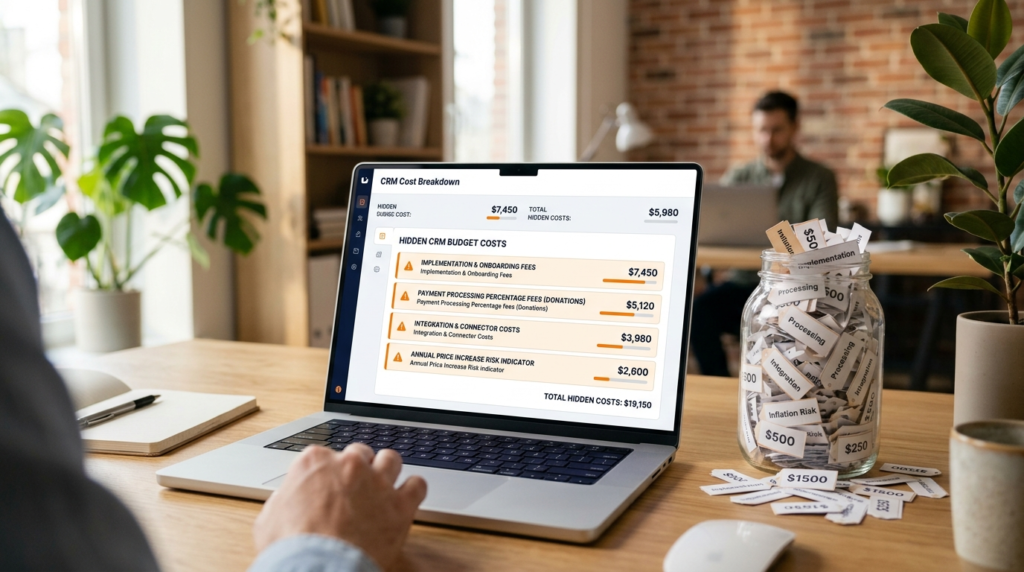
Hidden Costs That Double Your CRM Budget
Every vendor pricing page shows the subscription. None of them show this:
- Implementation and onboarding. Most CRMs charge separately for setup, data migration, and training. Purpose-built nonprofit CRMs (Bloomerang, NeonCRM) often include onboarding in base pricing; Salesforce and HubSpot Professional require paid implementation support. Always ask: “What is the full onboarding cost for an organisation our size?”
- Payment processing fees. CRMs that process online donations charge 2.2%–2.9% plus a per-transaction fee. On $200,000 in annual donations, the difference between 2.2% and 2.9% is $1,400/year — more than many CRM subscription fees. Compare payment processing rates as carefully as you compare subscription prices.
- Integration costs. Connecting your CRM to email marketing, event management, or accounting tools may require a paid Zapier plan, a HubSpot marketplace app, or custom development. Always ask: “What does it cost to connect to the tools we already use?”
- Annual price increase risk. Ask each vendor whether they publish their annual price increase rate and whether there’s a contractual cap. Most won’t answer this proactively. The question itself tells you whether you’re talking to a vendor that plans to raise prices quietly.
- Staff time. Free tools carry real hidden costs in hours spent on manual data entry, spreadsheet reconciliation, and workarounds. When evaluating a free plan, estimate the monthly staff hours saved by upgrading and multiply by your average hourly staff cost. For many nonprofits, a $99/month paid CRM is cheaper than the free alternative once staff time is included.
Which CRM Tier Is Right for Your Nonprofit? A Budget Framework
| Annual budget | Typical CRM spend | Recommended tier | Best options |
| Under $150K | $0–$150/month | Free tier or entry-level paid | HubSpot Free CRM, Little Green Light, NeonCRM Essentials, spreadsheets + Mailchimp |
| $150K–$500K | $100–$400/month | Mid-tier nonprofit CRM | Bloomerang, NeonCRM, HubSpot Professional (40% off via nonprofit program) |
| $500K–$2M | $300–$800/month | Full-featured nonprofit CRM | Bloomerang, NeonCRM, Salesforce NPSP (if IT resources available) |
| Over $2M | $800+/month | Enterprise or custom | Salesforce Nonprofit Cloud, Blackbaud, custom build |
Budget ranges are estimates based on third-party market research (April 2026). Actual costs vary by organisation size, donor volume, and feature requirements.
Here’s the honest read on that table: most nonprofits in the $150K–$500K range are sitting on the HubSpot Free CRM trying to make it work past the point where they should have upgraded.
At 40% off, HubSpot Professional at ~$480/month base is meaningfully more accessible for that budget tier than the commercial rate suggests.
See the full HubSpot nonprofit discount guide for eligibility requirements.
Ready to Apply for a Nonprofit CRM Discount?
For nonprofits in the $150K–$500K budget range, HubSpot Professional with the 40% nonprofit discount is the most accessible step up from a free CRM.
See the full guide to eligibility and how to apply.

Nonprofit CRM Pricing: Where to Start
The most common mistake I see nonprofits make: choosing a CRM based on brand recognition rather than pricing model fit.
Salesforce is genuinely the right tool for large nonprofits with IT staff and a dedicated administrator.
It’s a poor fit for a 12-person team that just wants to track donors without hiring a consultant.
The decision framework above is where I’d start. Figure out your budget tier first, then look at the platforms that fit it.
The purpose-built CRMs (Bloomerang, NeonCRM, Little Green Light) will almost always win on ease of implementation for small teams.
The general-purpose SaaS CRMs with nonprofit discounts (HubSpot) close the gap on price for mid-size nonprofits that also need marketing automation.
For nonprofits evaluating both CRM and the broader operational tool stack — project management, communication — the individual discount guides in this cluster cover each platform’s program in detail.
And if you’re evaluating CRM options for a team that has both commercial and nonprofit functions, I’ve covered CRM tools for B2B teams in the broader SaaS pricing cluster as well.
Frequently Asked Questions
How much does a nonprofit CRM cost?
Small nonprofits typically pay $1,200–$3,600/year for a mid-tier CRM subscription, per liveimpact.org research from April 2026.
Entry-level purpose-built CRMs start at $45–$99/month.
General-purpose SaaS CRMs with nonprofit discounts (HubSpot Professional at 40% off) sit in the mid tier. Implementation, onboarding, and payment processing fees often add significantly to the subscription cost in year one.
See the comparison table and budget framework in this article for platform-by-platform detail.
What CRM do most nonprofits use?
Salesforce NPSP and Bloomerang are the most widely cited in the sector.
HubSpot Free CRM is widely used by smaller nonprofits for contact management and basic email outreach.
Many small nonprofits use spreadsheets or Airtable as de facto CRMs before making a formal switch.
The comparison table in this article covers eight platforms across both purpose-built and general-purpose categories.
Is Salesforce free for nonprofits?
Partially.
Salesforce offers 10 free licenses via the TechSoup Power of Us program.
Additional licenses are discounted — third-party estimates put the starting price at approximately $36/user/month for eligible nonprofits, but Salesforce doesn’t publish a fixed nonprofit rate.
More importantly, the free licenses don’t cover implementation, which typically costs $15,000–$100,000+ for a mid-sized nonprofit.
See the full TCO breakdown in this article before assuming Salesforce is a free option.
Does HubSpot have a free nonprofit CRM?
Yes. HubSpot Free CRM is available to all organisations at no cost — no application required, no nonprofit status needed. I
t includes contact management, deal pipelines, email marketing, and basic reporting.
For growing nonprofits that need marketing automation, HubSpot Professional offers a 40% discount for eligible organisations in North America, Australia, and New Zealand.
See the full HubSpot for Nonprofits guide for eligibility and how to apply.
What is the best affordable CRM for nonprofits?
It depends on your organisation size and needs. For budgets under $150K/year: HubSpot Free CRM or Little Green Light ($45/month).
For $150K–$500K: Bloomerang, NeonCRM Essentials ($99/month), or HubSpot Professional with the 40% nonprofit discount.
There’s no single best option — the right answer comes from your budget tier, your team size, and whether you primarily need donor management or broader marketing automation.
The budget framework in this article is designed to answer this question for your specific situation.
Sources
- Bloomerang pricing analysis — grantpipe.com, April 2026
- NeonCRM pricing — Capterra, April 2026
- Little Green Light vs NeonCRM comparison — Capterra, March 2026
- Salesforce nonprofit pricing page
- Salesforce Power of Us program
- Salesforce NPSP pricing and implementation costs — costbench.com, May 2026
- Nonprofit CRM pricing benchmark — liveimpact.org, April 2026
- HubSpot pricing

Recent Posts
Monday.com Review 2026: Is It Still the Best Work OS?
I tested Monday.com against ClickUp, Asana, and Wr...
Updated July 27, 2026

AI Writing Software for Blogging in 2026: Best Tools + How to Stay AI-Search Vis...
The best AI writing software for blogging in 2026 ...
Updated July 20, 2026
HubSpot Review 2026: Is It Worth the Cost?
I tested HubSpot’s free CRM, Starter, and Pr...
Updated July 20, 2026
Teamwork.com Review 2026: Is It the Best PM Tool for Client Work?
I tested Teamwork.com for agency and client projec...
Updated May 29, 2026
Wrike Review 2026: Is It Worth the Cost?
I tested Wrike in real enterprise workflows. Here&...
Updated May 29, 2026
Asana Review 2026: Is It Worth It? (Honest, In-Depth Analysis)
I tested Asana across real team workflows. Here...
Updated May 29, 2026
Newsletter
Don't miss a thing!
Sign up to receive daily news